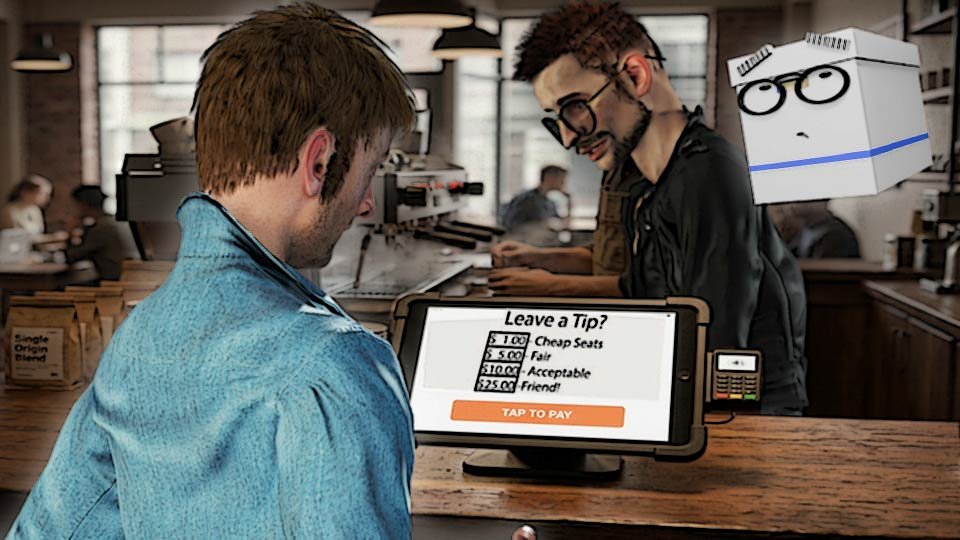
Marty ordered a single coffee. One coffee. A beverage that involved a machine and roughly eleven seconds of another human’s time. The card reader spun around to reveal three preset tip options, the lowest of which was still a genuinely startling percentage of four dollars.
He stood there, frozen, doing quiet, anxious math in front of a growing line of people, all of whom were presumably judging him for taking so long to decide the fate of sixty cents.
🍽️ Restaurants: The Most Established Baseline
Sit-down restaurant service is the one category almost everyone already agrees on: roughly 15-20% of the pre-tax bill for typical service, higher for something genuinely excellent.
It’s honestly fine to tip less for service that was genuinely bad — not “they forgot the extra napkins” bad, but “you had to physically go find your own server” bad.
Most people default toward the higher end of that range without thinking too hard about it, which is a perfectly reasonable way to not have to digest numbers while digesting dinner.
🚗 Delivery and Rideshare: A Real, Expected Category
Food delivery and rideshare drivers genuinely rely on tips as real income, not a bonus, the same way a restaurant server does.
A common range is 15-20%, or a flat few dollars for a short trip.
It’s worth treating this category with the same seriousness as sit-down dining, not as some kind of optional extra.
The driver isn’t tangential to the transaction. He is, structurally, most of it.
💇 Personal Services: Hairdressers, Barbers, and Similar
Generally 15-20%, same as a restaurant.
One wrinkle worth knowing: some salon owners who own their own chair don’t expect a tip the same way an employee stylist does, since they’re not splitting the proceeds with a business owner above them.
This is a genuinely normal thing to just ask about directly — “do you take tips?” is not an awkward question, it’s a completely standard one, asked constantly, by people who did not want to do the math either.
📱 The Tablet-Turned-Toward-You Situation: You Genuinely Have Options
Counter service — coffee shops, quick takeout, the eleven-second transactions of the world — is where tipping culture has expanded fastest and least consistently, and it’s worth understanding why that screen makes you feel the way it does before deciding what to do about it.
Those preset percentages aren’t neutral. They’re deliberately set high, because a screen that starts at 25% makes 15% feel like the stingy option, even on a four-dollar coffee that took eleven seconds to make. That’s not etiquette. That’s a psychology experiment wearing a payment terminal’s clothes.
So, the actual solution: decide your own policy in advance, before you’re standing there with a line behind you and a cashier definitely not watching your screen nearly as closely as you assume they are.
A reasonable, defensible line is to tip when something was genuinely made for you — a latte someone actually steamed and poured, a sandwich someone built — and to skip it, guilt-free, for something that was just handed to you, like a bottled drink or a bag of chips rung up at a register.
Hit “custom amount,” type in zero, and move on with your day. The moment of awkwardness lasts about two seconds and is forgotten by literally everyone else in that line before they’ve even reached the counter.
A tablet prompting you is a business choice, not a social contract. You’re allowed to treat it as optional, because it is.
🏨 Hotels: An Easy Category to Forget Entirely
Housekeeping is worth a few dollars a day, left directly in the room — in cash, and clearly marked (a small envelope, a note that says “thank you”) so it doesn’t get mistaken for money someone accidentally left behind and skipped entirely.
This is genuinely easy to forget, since unlike a server, housekeeping staff are rarely standing there for you to hand something to directly. Nobody’s going to chase you down about it.
That’s exactly why it’s worth building the habit of leaving it before you check out, not after you’re already in the elevator wondering if you should have.
🎯 The General Principle Underneath All of This
Tipping norms genuinely vary by service type, by region, and sometimes by the individual business you happen to be standing in.
When you’re truly unsure, a quick, discreet search for “tipping norms for [specific situation]” settles most uncertainty faster than the anxious math Marty was doing in that coffee line.
And here’s the part worth actually believing: nobody has ever once been offended by a guest who clearly put a little thought into it — whichever way that thought landed.
🔗 Related Reads
- What to Bring When You’re a Dinner Guest
- Houseguest Etiquette: What You Owe the Person Putting You Up
- Small Talk: How to Actually Start and Exit a Conversation Gracefully
ScrumbleDoc is part of the WhistleBump Group — find the rest of the family at WhistleBump.com.
54007
©2026 John D Reinhart/ScrumbleDoc.com — All rights reserved