
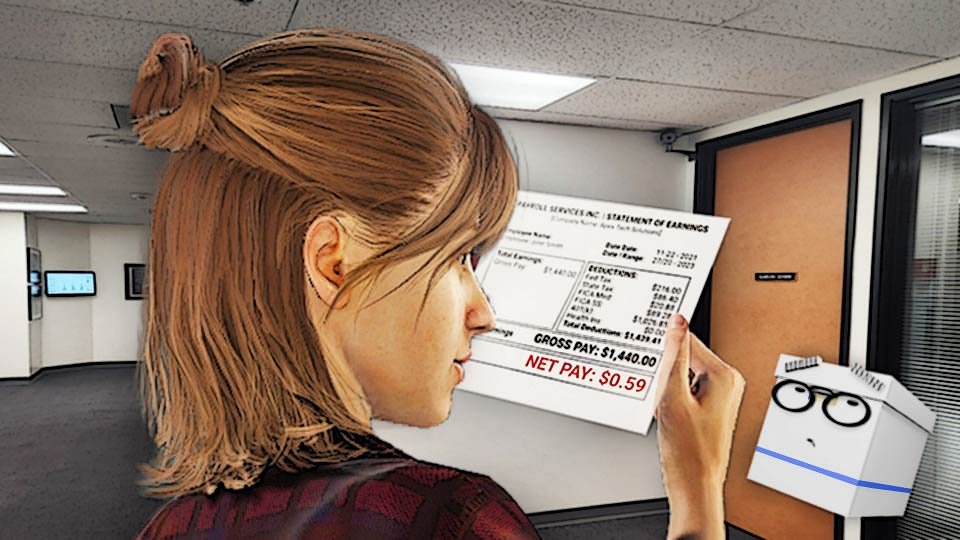
Alexa did the math before her first paycheck even arrived. $18 an hour, roughly 80 hours over two weeks, that’s $1,440, simple multiplication, she’d checked it twice.
The number that actually showed up in her account was $1,140. She stared at her phone for a solid minute, genuinely wondering if her employer had made a mistake, or possibly forgotten how multiplication works.
Neither. That missing $300 didn’t vanish. It went to exactly six specific places, all at once, all with their own names, none of which anyone had ever explained to her.
💸 The Two Numbers That Don’t Match: Gross vs. Net
Gross pay is the number you did the math on — hours times your rate, or your stated salary divided out per paycheck. It’s the full, pre-deduction amount your work actually earned.
Net pay, sometimes called “take-home pay,” is what’s left after everything gets subtracted out, and it’s the number that actually lands in your bank account.
Every single deduction on a pay stub is the gap between those two numbers, itemized. Nobody’s shortchanging you. The paycheck is just reporting both numbers, and only one of them was ever going to be spendable.
🏛️ FICA: The One Everybody Pays, No Exceptions
FICA stands for the Federal Insurance Contributions Act, and it funds two specific federal programs: Social Security and Medicare.
It’s 7.65% of your gross pay, combined — 6.2% to Social Security, 1.45% to Medicare — taken automatically from essentially every paycheck, at every job, regardless of income level or how much you like the idea.
This isn’t optional, isn’t a mistake, and isn’t specific to your employer. It’s federal law, applied the same way to nearly every paycheck in the country.
📋 Federal (and Sometimes State) Withholding
This is the government collecting an estimate of the income tax you’ll owe for the year, a little at a time, instead of asking you for one enormous payment next April.
The amount withheld is based on what you filled out on a form called a W-4 when you were hired — covered in its own post, since it’s worth understanding on its own — which tells your employer roughly how much to hold back from each check.
If you live in a state with its own income tax, a separate state withholding gets taken out too, right alongside the federal amount.
🧾 Other Things That Might Be Missing Too
Depending on your specific job, a few other deductions might be quietly doing their part: a health insurance premium, if you’ve opted into a plan through work.
A retirement contribution, like a 401(k), if you signed up for one.
These aren’t hidden fees — they’re things you actually chose, usually during onboarding paperwork that felt like a blur at the time, which is exactly why they’re worth double-checking on your first real pay stub rather than assuming you remember every box you checked.
🧮 A Quick Walkthrough With Real Numbers
Take that $1,440 gross paycheck. FICA takes roughly $110 (7.65%). Federal withholding might take another $140 or so, depending on the W-4 on file and how much was actually earned. State withholding, if applicable, takes a smaller additional slice.
Add it up, and a net paycheck landing somewhere around $1,140 to $1,200 isn’t a mistake at all — it’s the completely normal, expected result of gross pay meeting the standard set of federal deductions everyone runs into.
✅ The Actual Takeaway
The gap between gross and net isn’t a red flag, a clerical error, or your employer quietly skimming off the top. It’s the predictable sum of a handful of specific, named deductions, every one of which shows up right there on the pay stub if you actually read it line by line.
Once you know what each line is for, the smaller number stops feeling like a mystery and just becomes the number you were always actually going to take home.
🔗 Related Reads
- Reading Your W-2 Without Panicking
- How Tax Refunds Actually Work (It’s Not Free Money)
- How to File Your Taxes
ScrumbleDoc is part of the WhistleBump Group — find the rest of the family at WhistleBump.com.
56008
©2026 John D Reinhart/ScrumbleDoc.com — All rights reserved