
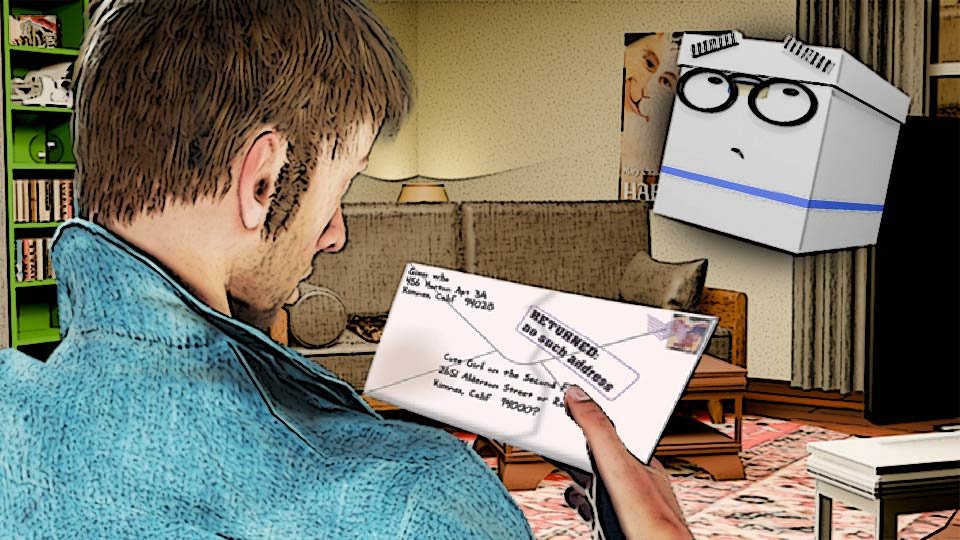
Marty needed to mail an actual physical letter for the first time in what felt like a decade, held a blank envelope in his hands, and realized with genuine alarm that he had no idea which corner anything went in — a task he was fairly sure he’d learned once, in childhood, and had since let quietly evaporate.
📬 The Recipient’s Address: Front and Center
The person you’re sending the letter to goes in the middle of the envelope, roughly centered, written across three lines: their name on the first line, street address on the second, and city, state, and ZIP code on the third.
This is the biggest, most prominent text on the whole envelope, and for good reason — it’s the only part the postal system actually needs to deliver it.
Make sure the bottom line of address (city, state, and zip) are at least an inch above the bottom of the envelope. This is the space the post office uses to apply a delivery barcode.
↖️ Your Return Address: Top Left Corner
Your own address goes small, in the top left corner — same three-line format as the recipient’s address, just your own information instead.
This isn’t required for delivery, but it’s essential if the letter can’t be delivered for some reason, since it’s how the post office gets it back to you instead of it vanishing forever.
You can handwrite your address, use one of the stickers that will invariably get sent to you by someone seeking donations, or use a rubber stamp. It doesn’t matter, as long as it stays in the upper left corner of the envelope.
🎫 The Stamp: Top Right Corner, Always
The stamp goes in the top right corner, full stop — this one’s non-negotiable, unlike some of the softer conventions elsewhere in this post.
A letter without postage simply doesn’t go anywhere, and a stamp in the wrong spot can genuinely confuse automated sorting equipment.
💰 How Many Stamps You Actually Need
A standard letter, standard size, one ounce or under, needs exactly one Forever stamp (a stamp that never expires or loses value, regardless of future postage price increases).
Anything heavier, oddly shaped, or oversized may need additional postage — worth a quick weigh or a trip to the post office counter if a letter feels notably heavier than a couple of sheets of paper.
A rule of thumb: if it makes you wonder if one stamp is enough, add another stamp.
✍️ A Few Formatting Details Worth Getting Right
Write clearly, ideally in dark ink.
The U.S. Postal Service actually prefers all capital letters with no punctuation for the address lines (their sorting machines read this format most reliably), though standard formatting works fine too — this is a nice-to-know, not a strict requirement for a personal letter.
Calligraphy is nice, but don’t use it to address the envelope – it can confuse the postal service’s scanning equipment.
📬 Why the Details Actually Matter
Here’s the part nobody explains: none of that address gets read by an actual human being who cares about penmanship. It gets read by a scanner. A fast one. The postal service runs enormous machines that photograph your envelope and pull the address apart, line by line, looking in very specific spots for very specific information.
The recipient’s name goes on one line. The street address goes on the next. City, state, and ZIP go on the line after that. The scanner isn’t reading your envelope like a paragraph — it’s reading it like a form, and it expects each piece of information to show up exactly where a form would put it.
Get the order right, and your letter gets sorted automatically in about the time it takes you to read this sentence. Get it wrong — swap two lines, scribble the ZIP code somewhere creative — and the machine can’t make sense of it.
That’s when a letter gets kicked out for a human to sort by hand, which is slower, or misrouted entirely, which is worse. Or, if you supplied a return address, it comes back to you.
All of which is to say: this isn’t etiquette for etiquette’s sake. It’s just, unglamorously, how to talk to a machine that’s about to decide where your letter ends up.
🛠️ Gear Worth Having
ExcelMark Personalized Return Address Stamp — stamp your return address in two seconds instead of hand-writing it every single time — genuinely worth it the moment you’re sending more than one or two letters a year.
As an Amazon affiliate, I earn from qualifying purchases. Thank you for supporting ScrumbleDoc.
🔗 Related Reads
- Thank-You Notes: When You Actually Need to Write One
- Sympathy Cards: What to Actually Write When You Don’t Know What to Say
- RSVP: What It Actually Means and Why Ignoring It Is Rude
ScrumbleDoc is part of the WhistleBump Group — find the rest of the family at WhistleBump.com.
54010
©2026 John D Reinhart/ScrumbleDoc.com — All rights reserved