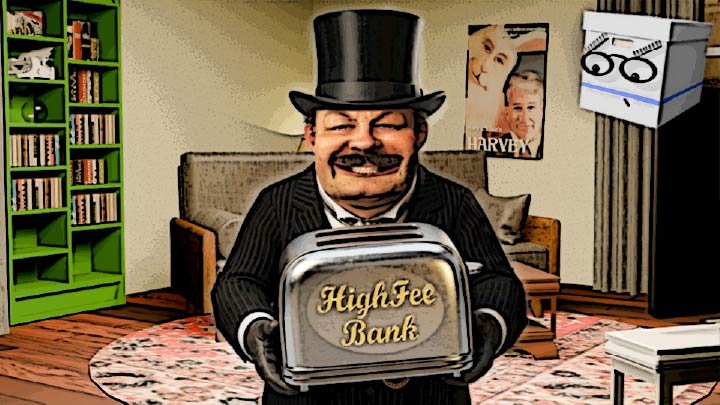
Marty picked his current bank because it had a branch near his college and gave him a free water bottle for opening an account — a decision-making process he now recognizes, three years later, as roughly equivalent to picking a doctor based on how good the waiting room magazines were.
The water bottle is long gone. The bank, and its fees, are still very much here.
🏦 Bank vs. Credit Union: The First Real Fork
There are three ways to manage your money: a commercial bank, a credit union, or a shoebox under the bed.
The shoebox has zero fees and zero customer service hold music, which is the entire pitch — right up until you try to deposit a check into it, at which point it stops being a financial strategy and starts being a fire hazard.
A commercial bank is a for-profit business owned by stockholders, built to make money off you in order to pay those stockholders. In exchange, it usually offers bigger budgets — nationwide ATM networks, slicker apps, branches in more zip codes than you’ll ever visit.
A credit union is a non-profit financial cooperative owned by its own members — meaning the people with accounts there aren’t just customers, they’re technically part-owners. Instead of sending profit to outside investors, a credit union routes it back to members as lower fees, better loan rates, and higher interest on savings. The tradeoff is a smaller physical footprint, though plenty share ATM networks with other credit unions so this hurts less than it used to.
The short version: if you travel a lot and want a slick app and branches everywhere, lean commercial bank. If you want lower fees and better rates and don’t mind fewer physical branches, lean credit union.
💻 Online-Only Banks: The Third Option Most People Forget
Some banks exist entirely online, with no physical branches at all. Because they’re not paying rent on real estate or salaries for tellers, they can usually pass some of that savings on to you as better interest rates and lower fees.
The tradeoff is exactly what it sounds like — there’s no branch to walk into. That matters most when you’re applying for a loan or trying to untangle a genuinely messy account problem, the kind that’s painful to solve entirely through a chat window.
Day-to-day, though, it’s less of a gap than it feels like: you can deposit checks through the app, and most online banks reimburse you when you’re forced to use a third-party ATM and get hit with a surcharge.
An important distinction: online-only banks like SoFi and Discover Bank are still FDIC-insured (Federal Deposit Insurance Corporation — the federal program that protects your deposits, up to $250,000, even if the bank itself fails). Popular fintech apps like Venmo and Chime are not banks and are not FDIC-insured on their own — they’re financial transaction businesses that typically hold your money at a partner bank behind the scenes. Worth knowing before you treat one like your main account.
💸 The Fee Structure Actually Worth Comparing
Every bank and credit union makes money two ways. First, by investing the money you deposit — stocks, bonds, loans to other customers, all the usual machinery. Second, by charging you directly for the privilege of managing your money. That second part is the one you actually have some control over.
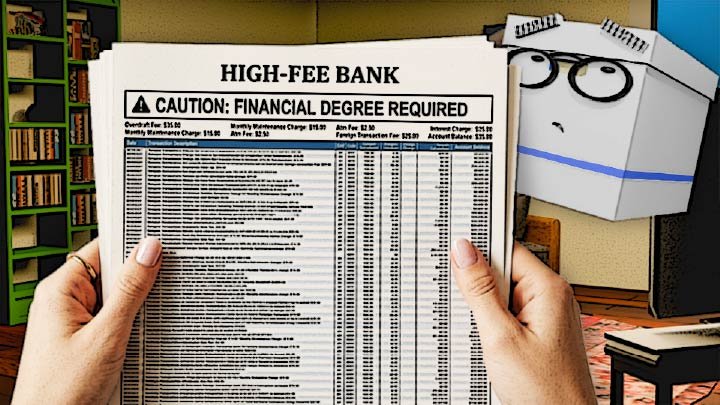
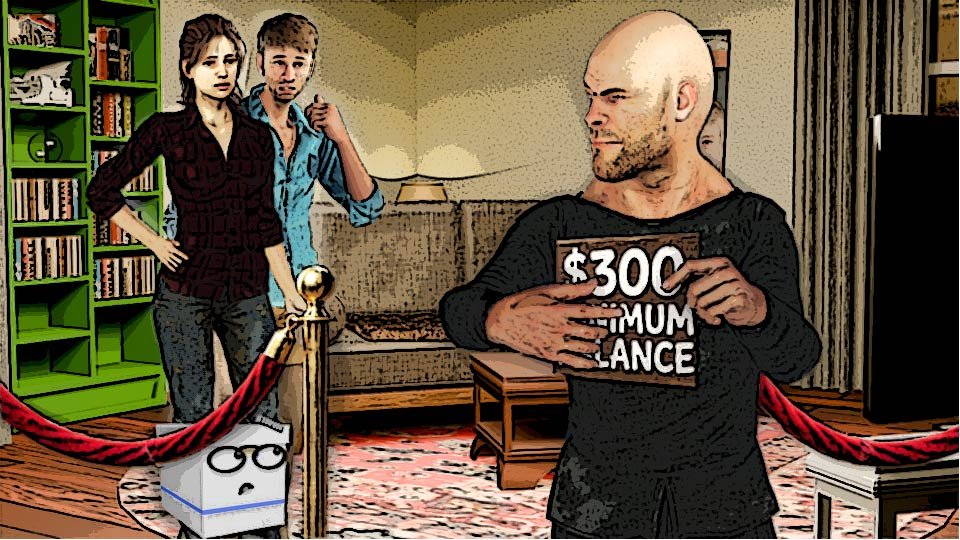
When you’re comparing institutions, read the fee schedule like it’s the only part of the brochure that matters, because it is. Look at the monthly maintenance fee and exactly what waives it — usually a minimum balance or a set number of direct deposits. Look at overdraft fees, out-of-network ATM fees, and any minimum balance requirement. These are the costs that show up every single month, quietly, forever.
A free toaster is a one-time event. A $12 monthly maintenance fee is a $144-a-year subscription you didn’t mean to sign up for.
🗺️ ATM Access: A Bigger Deal Than It Sounds
Smaller banks tend to have smaller ATM networks, and bigger banks tend to charge you for using their machines with a smaller bank’s card — sometimes both banks charge you for the same withdrawal, which is a special kind of insult.
If your bank’s network is thin and you’re regularly pulling cash from other banks’ machines, those fees add up faster than they seem like they should.
Before you assume ATM access “doesn’t matter,” take an honest look at whether your actual daily life — your commute, your neighborhood, your usual errands — overlaps with a given bank’s ATM footprint.
📱 The App Actually Matters More Than It Used To
The truth is, the vast majority of your relationship with a bank happens on your phone — checking balances, depositing checks, moving money, catching fraud alerts before they become a real problem. For most people, the app isn’t part of the bank experience. It is the bank experience.
A clunky, unreliable, hard-to-navigate app is more than an annoyance — some banks clearly haven’t grasped that their app is their lobby now, and a bad lobby says something about the business behind it.
Before you commit, look up the app in your phone’s app store and actually read the reviews. If a bank can’t get its app to work, it’s fair to wonder what else isn’t working behind the curtain.
🎯 The Actual Decision Framework
At the end of the day, the right bank depends on the kind of banking you’ll actually be doing — not the banking you imagine you might someday do.
Mostly staying local, writing the occasional check, not doing much traveling? A credit union’s smaller ATM network probably covers you fine, and you’ll come out ahead on fees and rates.
Moving around a lot — between cities, between states, between apartments? A traditional bank’s wider ATM network and branch access starts earning its keep.
Mostly just paying rent, depositing a paycheck, and rarely touching cash? An online-only bank can genuinely be the best deal on the table, as long as you’re comfortable never setting foot in a branch.
Whichever direction you’re leaning, take a real look at the fees, the interest rates, the ATM access, and the app — and match all four against how you actually bank, not how a commercial made you picture yourself banking. That’s the whole decision.
🔗 Related Reads
ScrumbleDoc is part of the WhistleBump Group — find the rest of the family at WhistleBump.com.
50009
©2026 John D Reinhart/ScrumbleDoc.com — All rights reserved